

For the first time, the Loewe Foundation Craft Prize is coming to Singapore.
View this post on Instagram
Launched by the Loewe Foundation in 2026, this award “aims to acknowledge the importance of craft in today’s culture and to recognise artists whose talent, vision and will to innovate promise to set a new standard for the future”. In its ninth iteration, it has become a global phenomenon, receiving over 5,100 submissions from artists around the world.
30 finalists have been chosen by an experts panel and a jury of 12, including creative directors Jack McCollough and Lazaro Hernandez, as well as the winner of the Loewe Foundation Craft Prize 2025, Japanese ceramicist Kunimasa Aoki. Representing 19 countries, these finalists work across a range of media including ceramics, woodwork, textiles, furniture, bookbinding, glass, metal, jewellery and lacquer.
The winner of the Loewe Foundation Craft Prize 2026 will be announced on May 12, 2026. Their work will subsequently be showcased from May 13-June 14, 2026, at the National Gallery Singapore, home to the world’s largest collection of Southeast Asian modern and contemporary art, comprising more than 8,000 artworks spanning the 19th century to the present.
From the list, we highlight 12 artists from Asia, bringing their unique background and perspective to their craft.
Take a closer look at the artwork of Loewe Foundation Craft Prize 2026 finalists from Asia.
Chia-Chien Hsieh (Taiwan)

Chia-Chien Hsieh, ‘Rhythm in Grid’, bamboo, urushi, dye, 700 × 700 × 700 mm (2025)
Chia-Chen Hsieh is a Taiwanese artist and visual arts educator trained in the Department of Fine Arts at the National Taiwan Normal University, Taipei. After graduating in 1986, Hsieh taught the visual arts curriculum across three junior high schools over a period of 27 years. She also serves as a visiting professor at various institutions, teaching the traditional craft of bamboo weaving. In 1999, she learned bamboo weaving through a preservation and training programme by National Craft Achievement Award winner, National Living Treasure and Preservation Bearer of bamboo craft in Taiwan, Li Jung-lieh.
This cubic structure has been crafted entirely from bamboo, using the material as both structure and surface. A bamboo grid defines the external framework, while thousands of specially treated, ultra-thin strips have been curved, layered and suspended within the grid’s internal volume. These interwoven elements form a continuous spherical ripple pattern, pushing the inherently rigid material to the limits of its pliability. Through the relationship between square and sphere, static and dynamic, cycles of nature and constant change, the structure brings traditional bamboo craft into a contemporary sculptural context.
Adelene Koh (Singapore)

Adelene Koh, ‘Endless’, paper, embroidery threads, aluminium wire, 120 × 120 × 55 mm (2025)
Adelene Koh is a Singaporean book artist, bookbinder and conservator based in Tainan. In 2011, Koh began bookbinding professionally and established ‘dddots’, her fine bookbinding service. She was first trained by Yamazaki Yo and Nishio Aya in Tokyo and then by Mark Cockram in London. She received two consecutive awards in The Bookbinding Competition, London (2014 and 2015), and in 2017 she received her first international prize at the Open Set Competition held by the American Academy of Bookbinding, Telluride.
In “Endless”, the endband—usually hidden within a book’s spine—has been expanded here into a continuous, meditative structure where sewing, colour, and rhythm become the form itself. Sewn around a single aluminium wire core, the artist employs embroidery threads and the front bead method: an English-style of endband sewing from the 18th and 19th-centuries. Hand-folded and hand-cut pages have been formed into quires, each with an additional fold along the fore-edge, then sewn by hand onto the wire core. Through this process, a binding element typically concealed within the book has been transformed into a circular architectural form, treating bookbinding as a sculptural language defined by colour, rhythm and repetition.
Jong In Lee (South Korea)
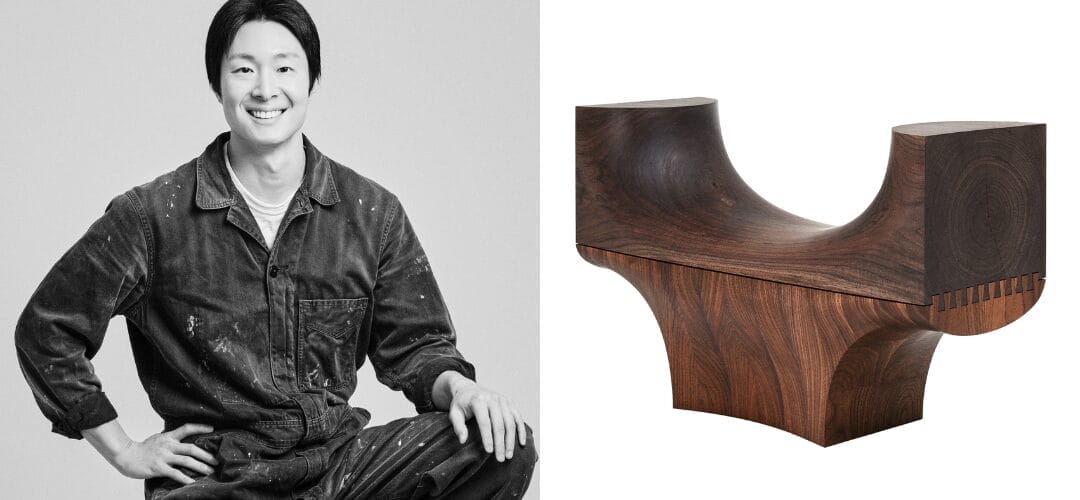
Jong In Lee, ‘Baeheullim’, walnut wood, 975 × 400 × 615 mm (2025)
Jong In Lee is a furniture maker based in Seoul. He began making furniture by observing his father, the contemporary wooden furniture artisan Mu Gyu Lee. His work is grounded in the understanding that furniture is a sculptural form
shaped by human physiological needs and must balance universal practicality with aesthetic quality. This sculptural bench is composed of two pieces of walnut: the upper carved from a single block to reveal accumulated grain and texture, and a lower section with vertically set grain, emphasising structural direction. Roughly shaped with a chainsaw, joined by a dovetail joint, and refined with a grinder and hand plane, the timbers expand and contract together over time, settling into a single body and creating visual balance within a potentially unstable form. He draws on baeheullim, a traditional Korean architectural technique which sees the subtle swelling at the waist of pillars.
Somyeong Lee (South Korea)

So Myeong Lee, ‘Chronicle of Matter’, comprised of ‘Chronicle of Matter 001’ and ‘Chronicle of Matter 002’, steam-bending oak, ocher, rope and mixed media, 600 × 1100 × 550 mm (2025)
These two four-legged forms have been made through a slow process of bending, weaving and binding thin, elongated pieces of oak. Steam-bent and shaped while hot to impart elasticity and tension, the pieces are joined by hand—a physical negotiation between resistance and flexibility. Ocher and string have been incorporated to create interaction between surface and structure, while the overall form adopts the architectural method of birds gathering branches to build a nest. Through a process of accumulation and cohesion, the work reconstructs materials as a metaphor for life, revealing strength and stability as outcomes of reliance, overlap and collective support.
Misako Nakahira (Japan)

Misako Nakahira, Interaction #YB’, wool, cotton, 1134 × 1023 × 8 mm (2024)
This tapestry has been constructed on a stretched cotton warp, forming a soft, folded surface that sits between painting and sculpture. Fine blended wool weft threads (‘mokuito’) have been handwoven, creating striped patterns in blue and yellow that overlap and disrupt one another. Subtle shifts in colour density produce illusions of layered depth across the pliable form. The reverse side is left visible, and the tapestry holds no fixed orientation, allowing light, movement and viewing position to continually alter its appearance. By destabilising the order of stripes on a fluid textile surface, the work confronts the tension between structure and ephemerality.
Jieun Park (South Korea)

Jieun Park, ‘Seed of Circulation’, oxidized sterling silver, linen thread, 153 × 153 × 254 mm (2025)
Rooted in natural rhythms of expansion and contraction, this dense sculptural form has been assembled from thousands of handmade sterling silver fragments, creating a compact, clustered, bulbous profile. These fragments are connected individually using linen thread, producing a flexible yet self-supporting surface. The repeated process generates a rhythmic pattern that balances regularity and variation, allowing the form to expand and contract while maintaining structural coherence. Like a seed, the form combines resilience and flexibility, containing the potential for expansion.
Jongjin Park (South Korea)
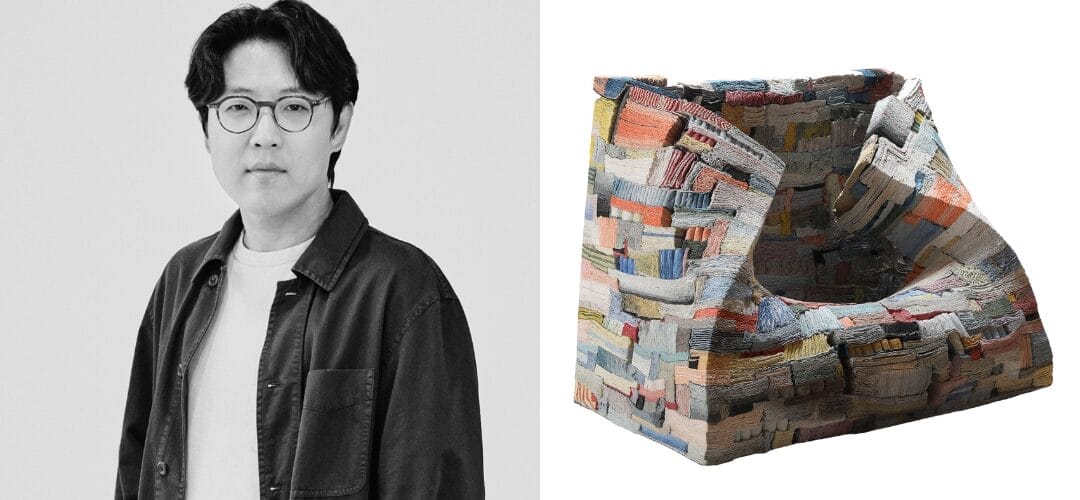
Jongjin Park, ‘Strata of Illusion’, porcelain, paper, stain, glaze, 750 × 450 × 560 mm (2025)
This warped rectilinear seating form has been built through stratified layering to form a compact ceramic volume. Sheets of paper have been coated with porcelain slip tinted with hand-mixed pigments, then folded, stacked and compacted by hand into a rectangular mass. Natural creases, compressions and shifts have been retained on the surface during shaping. After drying, the form has been oxidation-fired at 1280 degrees, converting the paper layers into a single ceramic body. Warping during firing produces an irregular, hollowed profile, which has then been reworked with electric tools to refine surface and structure. The work reflects the artist’s fascination with the instability of matter and captures the tension between control and collapse.
Coco Sung (South Korea)
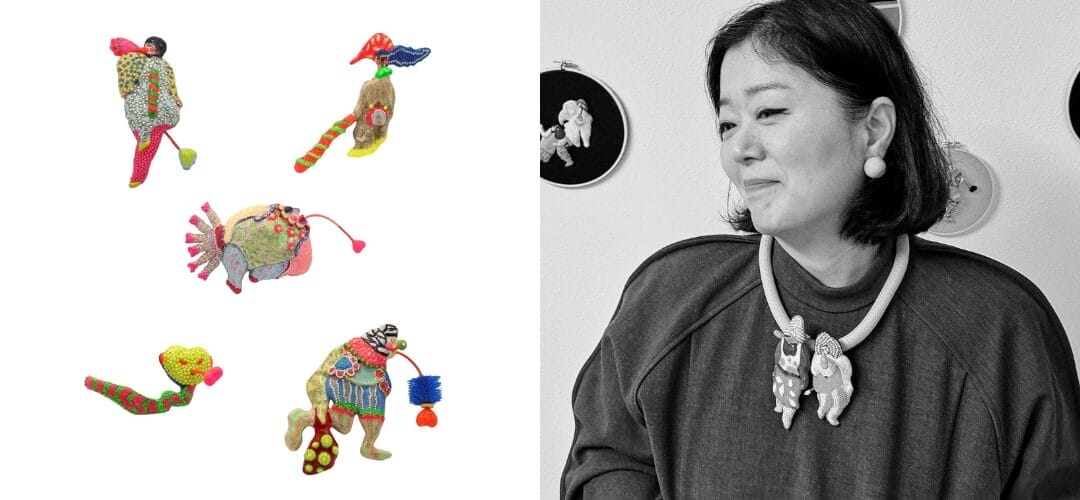
Coco Sung, ‘Shadow Kkokdu’, comprised of ‘Optak’, ‘Liebero’, ‘Pupillove’, ‘Bongja’ and ‘Pupsi’, clay, lacquer, coloured wire, beads, Swarovski stones, various dimensions (2025)
Born in the Republic of Korea and based in Berlin, Coco Sung is an artist working at the intersection of fine art and craft. These small, upright figurative forms have been entirely handmade using clay, beads, coloured wires, thread, lacquer and Swarovski stones. The forms are first constructed with wire and thread, before clay is applied to define the body and structure. Colour, beadwork and drawing are then layered onto the surface, creating concentrated points of reflection and ornament. The series reinterprets Kkokdu, figures from Korean funerary tradition who guide and protect the soul at the threshold
between life and death. Shaped as shadow-like talismans, the works embrace individuality and difference, warmth and humour, transforming mourning into a tactile language of care in the face of loss.
Nobuyuki Tanaka (Japan)

Nobuyuki Tanaka, ‘Inner side – Outer Side 2021 N’, lacquer hemp, 950 × 980 × 2080 mm (2021)
In 1985, Nobuyuki Tanaka completed an MFA programme in Crafts (Urushi Lacquer Art) at the Graduate School of Fine Arts, Tokyo University of Arts, Tokyo. Since then, he has developed his artistic practice around re-examining lacquer from a contemporary perspective. This tall, anthropomorphic vessel is a hollow, freestanding form informed by the vessel as a symbol of the body and made using the dry lacquer kanshitsu technique. Layers of hemp cloth have been built up over an inner styrofoam prototype, later removed to leave a lightweight, self-supporting structure approximately 5mm thick. Black lacquer has been applied in successive layers, each dried and polished with charcoal before final refinement. Repeated five times, this process has produced a smooth, reflective surface that emphasises the vessel’s continuous curves and upright presence.
Nan Wei (China)
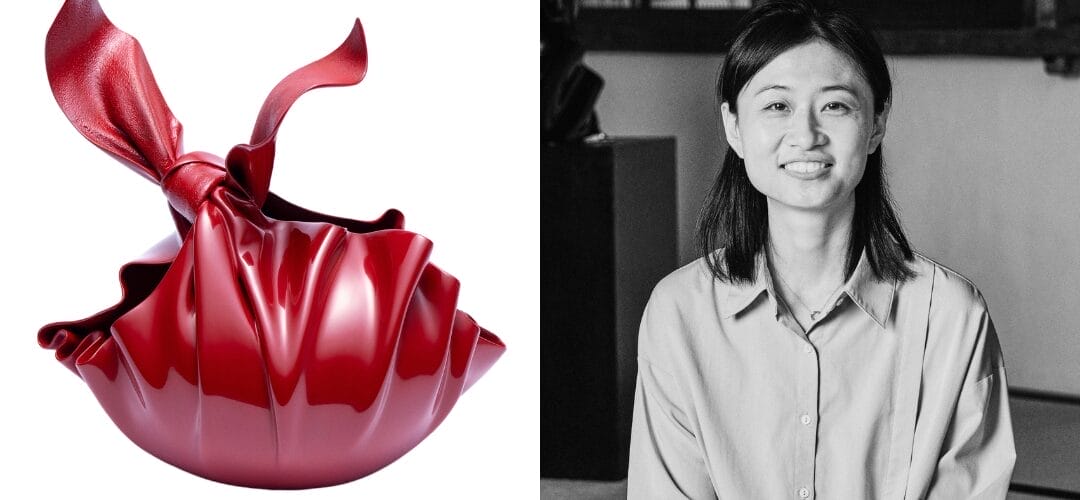
Nan Wei, ‘Knot-Loving’, lacquer, cow leather, linen, 190 × 230 × 250 mm (2025)
Nan Wei is a lacquer artist based in Kyoto. She has a BA in Art and Design from Beijing University of Technology, Beijing; an MA in Lacquer and Woodworking from Saga University’s Graduate School of Art and Regional Design, Saga, and a PhD in Fine Arts (Lacquer) from Kyoto City University of Arts, Kyoto. She is the recipient of the Grand Prize at the ART MEETS ARCHITECTURE
COMPETITION, Tokyo (2021), and the Kyoto Shimbun Prize at Kyoto Art for Tomorrow, Kyoto (2024).
To create this lacquered leather form, the artist has first stretched leather into a three-dimensional shape and impregnated it with raw lacquer, establishing lacquer as the hardening medium throughout the structure. Two external layers of linen are then applied, followed by four layers of scraped ash powder, each secured with lacquer. Five further layers of lacquer are subsequently built up, resulting in a form that is lacquered throughout its entire thickness rather than treated solely at the surface.
The exterior is extensively sanded and polished to achieve a smooth, high lustre finish, while the interior has retained its original appearance. By reworking the Japanese Shippi lacquer technique, which traditionally relies on the softness and elasticity of leather, the work situates lacquer craft within a contemporary, hand-scaled, fashion-orientated material context.
Ayano Yoshizumi (Japan)

Ayano Yoshizumi, ‘ICON #2507 Group’, comprised of ‘ICON #2507 No. 2’ (2025), and ‘ICON #2304 No. 3’ (2023), glass, acrylic paint, glitter, various dimensions
Treated as “three-dimensional canvases”, these two expressive glass sculptures have been hand blown into static moulds, then shaped and hot-torched to produce soft curves. While the moulds establish a structured base form, targeted heating has introduced twists and distortions that give the impression of movement within the glass. Colour patterns have emerged through this process, reflecting the material’s liquid state and emphasising shifts between interior and exterior space. Combining traditional mould blowing with experimental torch work, the works explore the transformative potential of hot glass through controlled deformation. Influenced by Fauvism, Minimalism, and with an awareness of Ma—the Japanese aesthetic sensitivity of space—colours, shapes, and light are composed as characteristic elements within the glass.
Soohyun Chou (South Korea)

Soohyun Chou, ‘Reconstructed Perspective Vessel 3C1L’, comprised of pieces 1-3, silicon bronze, copper, each 250 × 250 × 150 mm (2025)
Soohyun Chou is a jewellery artist, metalsmith and lecturer based in Seoul. Her work is centered on her self-developed modulated mould casting technique, a process of dividing and recombining forms, and her practice is guided by a close attention to the physical qualities and surfaces of metal. This group of three bronzes has been created by combining elements from two different mould sets, resulting in more complex and dynamic forms, each containing subtle variations and temporal depth.
A shaped copper inner wall has been inserted into each form to create a double-layered structure and their surfaces chemically oxidized to produce a deep black patina that shifts with light. This process functions as a sculptural experiment in which perception is shaped through an ongoing relationship between viewer, object and time.
