

Performative reading is in–and it now comes with a designer bag!
In his Spring/Summer 2026 collection, Jonathan Anderson curates a reading list; each book is embroidered onto the front of the iconic Dior Book Tote. They are faithful reproductions of each book’s first-edition covers. A part of his Book Cover collection, Anderson’s selection of books speaks to his journey as a fashion designer, from his formative years to his current position at the helm of one of the biggest fashion houses in the world.

A classic, tongue-in-cheek move from Anderson, these bags are a playfully literal interpretation of the Dior Book Tote. And they have sparked a lot of conversation: are they egging on the rising trend of “performative reading”, criticised for its faux intellectualism, where people only want to be seen in public as readers? In Meena Alexander’s viral essay for EE72, she observes that intelligence has become aspirational, predicting that intellectualism will be the next status symbol. In this case, two status symbols–old and new–come together.
In defence of Jonathan Anderson and the wider fashion industry, this is not necessarily a bad thing. When books become objects of desire, this can be seen as a way of protecting traditional art forms and pushing back against the attention economy as the digital world continues to peddle more and more quick fixes. Performative or not, the world is now clamouring to read these important, era-defining books from the 19th and 20th centuries; they are more open to examining issues of class, gender and sexuality from different historical time periods and relating it to the present. In this instance, they are able to gain a deeper insight into the stories that influenced one of the most coveted fashion collections of the season.
In this special edition of BAZAAR Books, we make our way through the books featured in Dior’s Book Cover Collection to pinpoint exactly why each one belongs on your reading list.
Les Liaisons Dangereuses by Pierre Choderlos de Laclos

(Photo: Heikki Kaski/ Dior)
Many may know the story of Les Liaisons dangereuses from its critically acclaimed 1988 movie adaptation, starring Glenn Close, John Malkovich, and Michelle Pfeiffer. Pierre Choderlos de Laclos’s original novel, published in four volumes in 1782, is a riveting tale in which lovers-turned-rivals Marquise Isabelle de Merteuil and the Vicomte Sébastien de Valmont destroy each other and everyone around them. Its epistolary format allows us to see the corruption of each character with each page as the plot unfolds through letters. Filled to the brim with seduction and intrigue, Les Liaisons dangereuses has always been a hit among readers. Marie Antoinette famously commissioned an illicit copy for her library after it was banned in 1823.
It asks the question: What happens to a group of people in the pursuit of power and unchecked ambition?
Madame Bovary by Gustave Flaubert

(Photo: Dior)
A story first serialised in the Revue de Paris in 1856 and later published as a two-volume novel, Madame Bovary was a controversial piece of work. Its author Gustave Flaubert was accused by a French prosecutor of causing an “offense to public and religious morality and to good morals” for publishing the novel; he was not convicted by the court. The outrage centred around its adulterous main character, Emma Bovary, who is disillusioned with provincial married life, escaping into “a marvelous world where all would be passion, ecstasy, delirium” through her affairs.
The genius of Flaubert emerges in the way he presents the thoughts of a deeply flawed Emma with dispassion and ambivalence, yet we are able to understand, and even empathise, with her actions. His writing style in Madame Bovary ushered in a new age of realism in literature, which we continue to see in present day works of literature.
Dracula by Bram Stoker
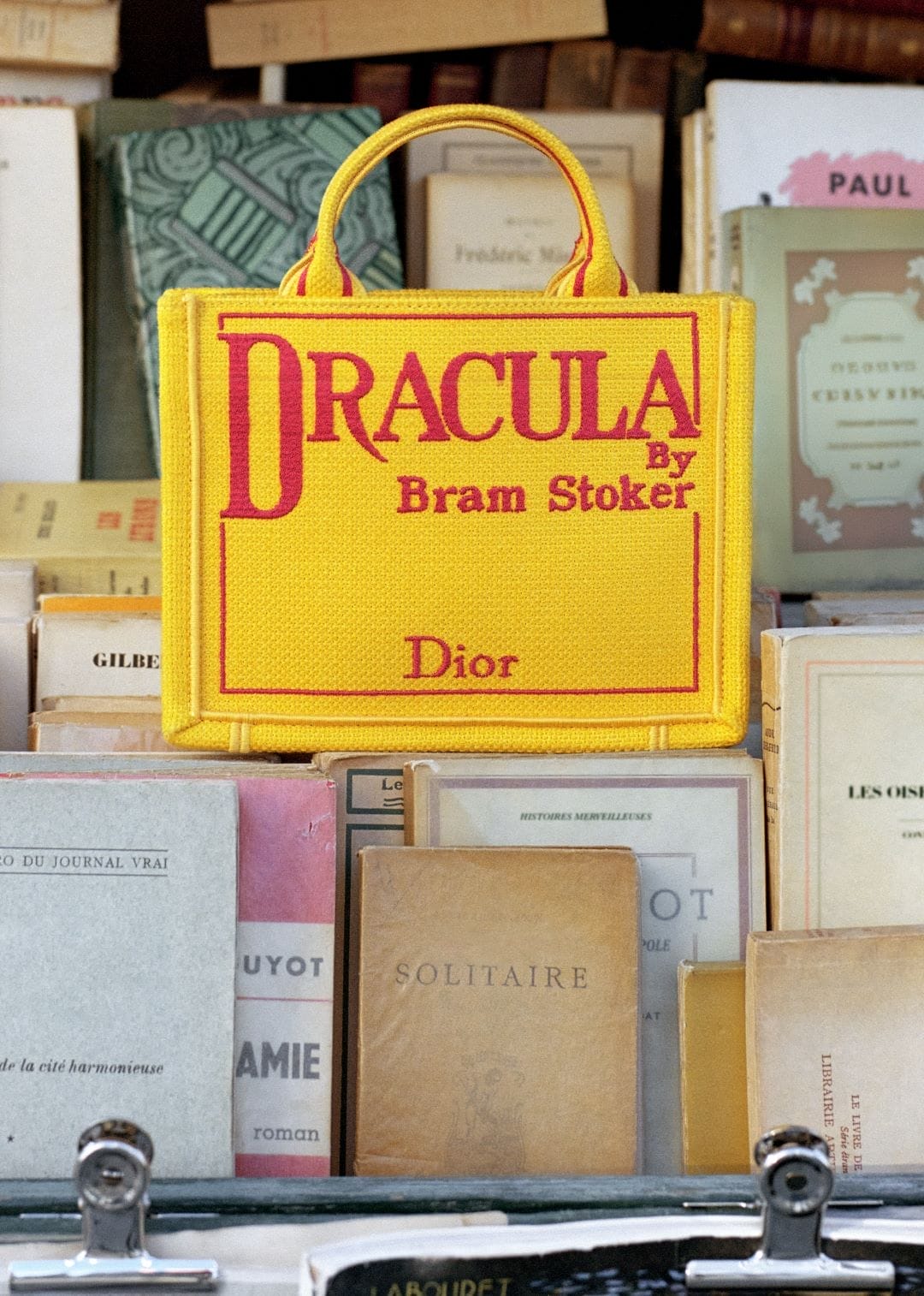
(Photo: Ivona Chrzastel/Dior)
Any study of Gothic literature will always include Bram Stoker’s Dracula. Published in 1897, this novel introduces the mythical vampire, as we know it today. Through this terrifying creature and its interaction with the human characters, the Irish writer reflects the fears of its readers in dealing with a rapidly changing society.
If you want a closer look into this Gothic novel, read our fashion editor’s in-depth review here.
Ulysses by James Joyce

(Photo: Heikki Kaski/Dior)
In a 2017 interview with AnOther Magazine, Jonathan Anderdon once wrote, “Irish people are very good at telling stories. Every country has an export, and I think it’s quite remarkable for such a small country to have had so many great writers come out of it. Irish literature is second to none, and for me that’s quite a proud thing.” It comes to no surprise that he has chosen to highlight James Joyce‘s 1922 masterpiece, Ulysses, which follows three characters–Leopold Bloom, his wife Molly Bloom, and Stephen Dedalus–on an ordinary day in Dublin, Ireland.
It is one of the most difficult novels to read on account of its revolutionary ‘stream of consciousness’ narrative style. Anderson himself admits it took him five years to finish the novel, but it “completely changed the way [he] saw literature”; and he is not alone. Joyce’s narrative style opens every artist’s eyes to the potential of breaking the rules and creating emotional impact even in the mundane; inspiring Virginia Woolf, Samuel Beckett, and now, Jonathan Anderson.
In Cold Blood by Truman Capote

(Photo: Heikki Kaski/Dior)
The only non-fiction novel on this reading list, In Cold Blood is written by American author Truman Capote. Regarded as one of the founders of New Journalism, where literary techniques are used to report on news and true stories, this novel tells the true story of the 1959 Clutter family murders in Holcomb, Kansas. It reconstructs the crime scene, and subsequently tracks the investigation, capture, trial and execution of the killers. In his research, Capote conducted hundreds of in-person interviews over six years. It results in an elucidation of the killers’ motives as well as a poignant portrait of a small farming community grappling with this horrific tragedy. For better or for worse (it is still hotly debated), In Cold Blood was a turning point for the true crime genre, shaping it to what we know today.
For additional reading, Capote details his six-year research process for this book in an essay published in A Capote Reader.
Les Fleurs du Mal by Charles Baudelaire

(Photo: Ivona Chrzastel/Dior)
Les Fleurs du Mal features all of Baudelaire’s poetry written between 1840 and 1867. Lusty and intoxicating, the rule-breaking poems are separated into six major themes: Spleen et Idéal (Spleen and Ideal); Tableaux parisiens (Parisian Scenes); Le Vin (Wine); Fleurs du mal (Flowers of Evil); Révolte (Revolt); and La Mort (Death). In each section, Baudelaire is unflinching in his portrayal of love, sex, and power during the time of Haussmann’s renovation of Paris, when the city he lived in was becoming unrecognisable to him.
Bonjour Tristesse by Françoise Sagan

(Photo: Ivona Chrzastel/Dior)
A coming of age novel for the ages, Françoise Sagan’s Bonjour Tristesse takes a seventeen-year-old out of boarding school to a dreamy villa outside of Paris for the summer. Carefree and self-absorbed, Cécile is on the brink of womanhood, navigating the relationships in her life. Published in 1954, when the author was only 18, the novel is an intoxicating portrayal of a young girl’s experience of hedonism and amorality, descending into chaos, tragedy and existentialism. By the end of the novel, readers will understand why Sagan derives the title from Paul Éluard poem, “À peine défigurée”, which welcomes sadness as an old friend.
Dior by Dior by Christian Dior

(Photo: Ivona Chrzastel/Dior)
One can only assume that the autobiography of the founding-couturier was a starting point for Jonathan Anderson when he was appointed as the creative director of Dior. The book follows Dior’s journey from a boy who loved the arts to becoming a world renown couture designer. The recreation of this book on the Dior Book Tote sees the signature title embroidered on a cream canvas, adorned with a delicate pink ribbon.

