

Taiwan Travelogue becomes the first book translated from Mandarin Chinese to win the International Booker Prize.
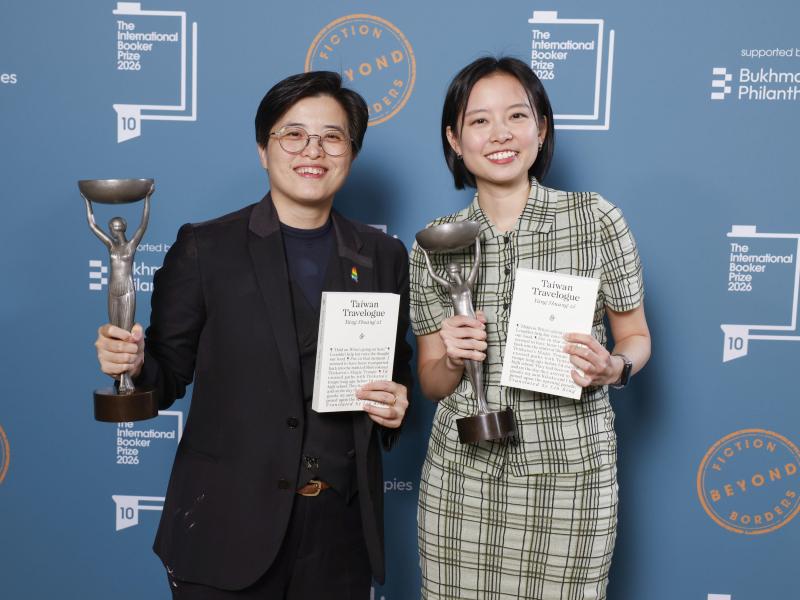
Yáng Shuāng-zǐ and Lin King win the International Booker Prize 2026.
“With narratives that capture moments from across the past century, these books reverberate with history. While there’s heartbreak, brutality and isolation among these stories, their lasting effect is energising,” says Natasha Brown, chair of this year’s judging panel for the prestigious literary award celebrating the best works of fiction translated into English. Brown and fellow judges, broadcaster Marcus du Sautoy, translator Sophie Hughes, Lowle Books founder Troy Onyango, and journalist Nilanjana S. Roy, had the difficult task of reading 128 novels and short story collection, and whittling down a longlist of 13 titles to a shortlist of six, and from there, selecting a winner.
At London’s Tate Modern on May 19, Taiwan Travelogue by Yáng Shuāng-zǐ, translated from Mandarin Chinese by Lin King, won the International Booker Prize 2026. The novel, which takes the form of a fictional translation of a rediscovered Japanese travel memoir, explores history, power, class, colonialism and love through the lens of two women’s culinary tour across Japan-controlled Taiwan in the 1930s.
View this post on Instagram
On behalf of the judging panel, Brown says, “This book doesn’t shy away from the complexities (both real and fictional) of its journey into the English language. Instead, it uses the hallmarks of a more traditional text–introductions, footnotes, afterwords–to wrap an intriguing metafictional layer around its core love story. Lin King’s deft translation perfectly conveys the nuances of the novel’s narrative voices. Taiwan Travelogue pulls off an incredible double feat: it succeeds as both a romance and an incisive postcolonial novel. As judges, we’ve enjoyed rich discussions about the many layers of this book. It’s a captivating, slyly sophisticated novel.”
In her winning speech, Yáng wades into the debate on whether art should be political: “Some people believe that art and literature should be kept far away from politics, but I believe that literature cannot be kept separate from the soil on which it has been grown. When surveying the modern history of Taiwanese literature, it becomes apparent that we writers have been asking the same questions for the past century. What kind of future do the people of Taiwan want?”
Her words are powerful against the backdrop of U.S. President Donald Trump’s recent state visit to Beijing, China, during which the ‘Taiwan issue’ was a great point of contention. Yáng continues, “Taiwan Travelogue joins the long list of texts that investigate these enquiries. Taiwan’s people have endured multiple colonial regimes and faced threats of invasion. When confronted with geopolitical forces so much greater than our own, what use do we have for literature? But I have always believed that literature wields power. It appears slow but it acts with steady resolve. It is often quiet but manages to spread ideas far and wide. There may be a time lag between the writing of a work and the translating of it. But translation allows literature to transcend the limits of time and space. I believe in literature’s power because in the life of the mind, literature has never ceded ground nor given up on the dialogue between people.”
Watch Yáng Shuāng-zǐ’s award acceptance speech, translated by Lin King, below.
Taiwan Travelogue was selected from a shortlist of six books, which represented eight countries (Brazil, Bulgaria, Canada, France, Germany, Taiwan, the UK and the United States) and four continents: Asia, Europe, North America and South America:
- The Nights Are Quiet in Tehran by Shida Bazyar, translated from German by Ruth Martin
- She Who Remains by Rene Karabash, translated from Bulgarian by Izidora Angel
- The Director by Daniel Kehlmann, translated from German by Ross Benjamin
- On Earth As It Is Beneath by Ana Paula Maia, translated from Portuguese by Padma Viswanathan
- The Witch by Marie NDiaye, translated from French by Jordan Stump
- Taiwan Travelogue by Yáng Shuāng-zǐ, translated from Mandarin Chinese by Lin King (WINNER)